
Key takeaways

  • Iquitos has no road connection to the rest of Peru, so you reach it only by air or river.
  • The fastest route is a flight from Lima to Iquitos, which takes just under two hours.
  • The airport sits about 10 km from the city center, with taxis and mototaxis handling the transfer.
  • Fly into Iquitos a day before your tour starts so a missed connection never costs you a departure.

You reach Iquitos by air or by river, never by car. The city has no road connecting it to the rest of Peru, so almost every traveler flies in from Lima on a flight that takes just under two hours. Once you understand that single fact, planning how to get to Iquitos becomes simple. This guide walks through your flights, your airport transfer, and how to line up your arrival with your tour so your Amazon trip starts without a hitch.
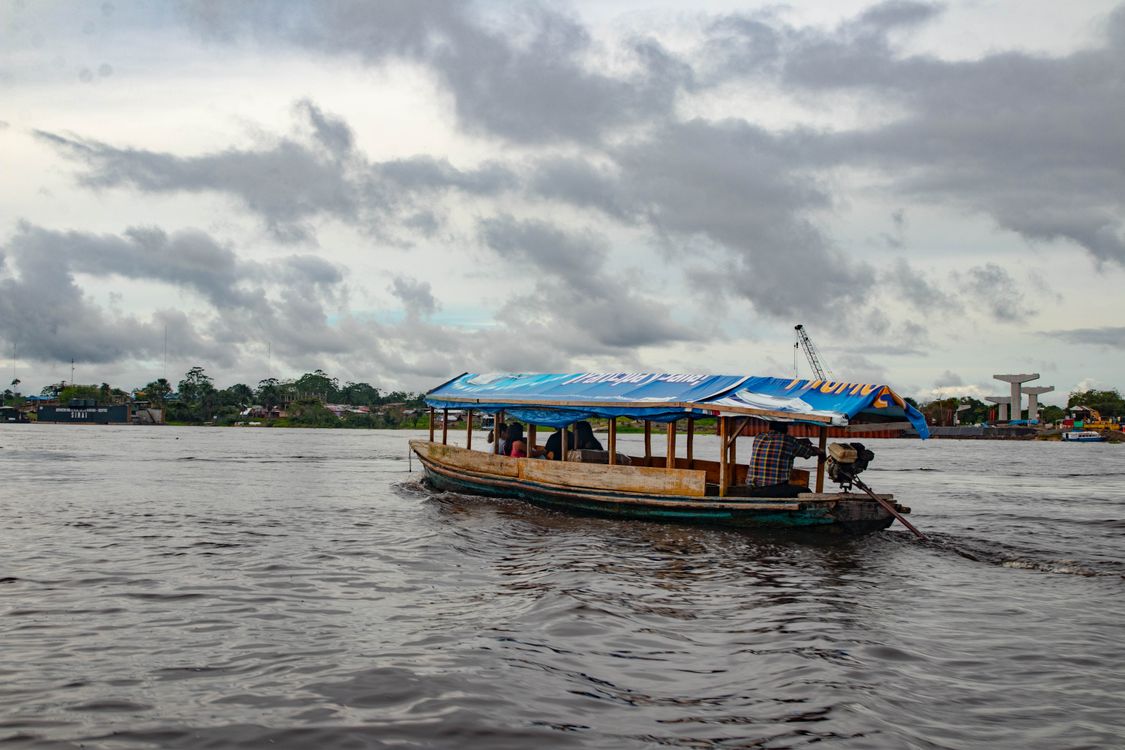
Traditional wooden boat navigating the Amazon River near Iquitos, Peru under cloudy skies

How to get to Iquitos by flying from Lima

Almost every visitor flies from Lima (LIM) to Iquitos (IQT), a trip of just under two hours over the Andes and into the rainforest. LATAM, Sky Airline, and Star Peru run the route, usually with several departures a day. If you are arriving from abroad, you connect through Lima's Jorge Chavez International Airport, then board a domestic flight north.

Book the Lima to Iquitos leg as early as you can. Seats on popular morning flights fill up, and fares climb closer to the date. A morning departure also lands you in Iquitos with daylight to spare, which matters when you still have a river transfer ahead.

Give yourself a comfortable buffer between an international arrival and your domestic flight. Peru requires you to collect checked bags and clear customs in Lima before re-checking for the domestic hop. Three to four hours is a sensible cushion. If the gap is tight, an overnight in Lima removes the risk entirely.

The airport in Iquitos is Coronel FAP Francisco Secada Vignetta International Airport, named for a local aviator. It handles the daily flow of travelers heading into the jungle and is your gateway to everything that follows.

Why does Iquitos have no road access?

Iquitos is the largest city in the world with no major road connection, a status confirmed by Guinness World Records (Guinness World Records, 2012). The single road leaving the city ends at Nauta, roughly 100 km to the south, so the municipality is reachable only by air and river. At the time of that record, Iquitos was home to about 430,000 people.

Dense rainforest, wide rivers, and seasonal flooding make a long highway through the region impractical. The Amazon and its tributaries have always been the natural roads here, carrying people and cargo the way asphalt does elsewhere.

What does this mean for you as a traveler? It means your plans hinge on two modes: a plane to get to the city, and a boat to get from the city to the jungle. There is no backup bus route if a flight is cancelled. That reality is exactly why a day of buffer in your schedule is worth so much.

The isolation is also part of the appeal. A place you can only reach by air or water still feels like a genuine frontier, and the river journey to your lodge becomes part of the adventure rather than a chore.

How do you get from the airport to the river port?

The airport sits a short drive from the Plaza de Armas, the city's main square, and the trip into town takes well under half an hour. Taxis wait outside the terminal, and so do the three-wheeled mototaxis that give Iquitos its soundtrack. A taxi typically runs higher than a mototaxi, but both are cheap by international standards. Agree on a price before you climb in.

If your trip is booked through a lodge, this part is usually handled for you. Jungle Wolf Expedition, for example, meets guests at the airport and manages the ground transfer to the river port, so you are not negotiating fares with your luggage on the curb. Confirm the pickup details in writing before you travel.

Boats to the jungle lodges leave from ports on the edge of town, such as Bellavista-Nanay where the Nanay River meets the Amazon. From there, a motorized canoe or riverboat carries you downstream to the lodge. The length of that ride depends on how deep into the rainforest you are headed.

Carry small bills in Peruvian soles for the transfer and any tips. Card payments are rare at the port, and a handful of coins solves most problems quickly.

When should you time your arrival with your tour?

Plan to land in Iquitos at least a day before your tour departs. Flights into the Amazon depend on weather and connections, and a single delay can cost you a scheduled boat departure that only runs once a day. An extra night in the city is far cheaper than missing the start of a multi-day trip.

Most lodge itineraries begin in the morning, when the river journey can be made in daylight and wildlife is most active. If your Jungle Wolf Expedition tour starts early, an afternoon or evening arrival the day before puts you in position without a frantic dawn scramble through the airport.

The buffer day pays off in other ways too. You arrive at the dock rested, you have time to repack for the humidity, and you meet your guide before the real journey begins. For help choosing the dates that suit your goals, our guide to the best time to visit the Peruvian Amazon near Iquitos breaks down the wet and dry seasons.

Check your flight status the night before and again on the morning of departure. Schedules on the Lima to Iquitos route can shift, and knowing early gives you room to adjust.

What should you know for your first hours in Iquitos?

Iquitos moves at the pace of the rainforest, hot, humid, and loud with mototaxi engines. Step out of the airport prepared for heat and sticky air year round. Light clothing, a hat, and water will carry you through those first hours far more comfortably than anything you packed for Lima's cooler coast.

Keep your travel documents and the bulk of your cash secure, and carry only what you need for the day. The Plaza de Armas and the riverfront Malecon are easy to explore on foot, with places to grab a meal before you head upriver. A short walk here is a good way to shake off the flight.

If you have a few spare hours, this is the moment to confirm every detail of your onward journey: your pickup time, your port, and your lodge contact. Sorting it now means no surprises when it is time to board the boat. Before you finish packing, our checklist on choosing an Iquitos rainforest lodge covers what to confirm with any operator.

Finally, slow down and take it in. You have reached a city at the heart of the Amazon that no road can touch. The adventure has already started.

To lock in a smooth arrival, book your Lima to Iquitos flight for the day before your tour, then message Jungle Wolf Expedition with your flight number so we can meet you at the airport and handle the transfer to the river.

Frequently asked questions

Can you drive to Iquitos?

No. Iquitos has no road link to the rest of Peru. The only road out ends at Nauta, about 100 km away. You can only reach the city by air or by boat on the Amazon River.

How long is the flight from Lima to Iquitos?

The flight from Lima to Iquitos takes just under two hours. LATAM, Sky Airline, and Star Peru run the route, usually with several departures each day.

How far is Iquitos airport from the city center?

Coronel FAP Francisco Secada Vignetta International Airport sits a short drive from the Plaza de Armas. A taxi or mototaxi covers the trip into town in well under half an hour.

Should I arrive the day before my jungle tour?

Yes. Arriving a day early protects you from flight delays and missed connections. It also gives you time to rest, adjust, and meet your lodge contact before heading upriver.

Key takeaways

  • The Peruvian Amazon near Iquitos has two travel seasons: high water from roughly December to May and low water from roughly June to November.
  • High water is best for canoe exploration through flooded forest and spotting pink dolphins; low water is best for hiking, fishing and finding wildlife near shrinking waterways.
  • Temperatures stay warm and humid all year, so your choice is driven by water level and activity, not by hot or cold weather.
  • Pacaya-Samiria National Reserve protects 2,080,000 hectares and records 1,025 vertebrate species, so wildlife is abundant in every month.

The best time to visit the Peruvian Amazon near Iquitos depends on what you want to do, because the region has two very different travel seasons rather than a clear good month and bad month. High water runs from roughly December to May and favors canoe exploration and dolphin spotting, while low water runs from roughly June to November and favors hiking, fishing and tracking wildlife on foot. Both seasons deliver dense rainforest and abundant animals. The water level, not the weather, is what reshapes your trip.

This matters because the lowland jungle stays warm and humid all year. You are not choosing between a hot season and a cold one. You are choosing between a forest you glide through by boat and a forest you walk into on exposed trails. Once you understand that single difference, picking your month becomes simple.

The Best Time to Visit the Peruvian Amazon: High Water vs Low Water

The Peruvian Amazon near Iquitos swings between a flooded high-water season and a receded low-water season, and the gap between them is dramatic. During high water the rivers rise many meters and push deep into the forest, turning woodland into navigable waterways. During low water the rivers pull back, exposing sandbars, beaches and muddy banks that were underwater weeks earlier.

High water typically peaks between March and May. Low water typically bottoms out between August and October. The transition months on either side give you a mix of both worlds, with falling or rising water and shifting wildlife. Because this cycle is driven by rainfall across the wider Amazon basin, not just local rain, the river can keep rising even on a sunny Iquitos afternoon.

This flood pulse is the defining feature of the region. It governs where fish go, where animals feed, and whether your guide reaches a given spot by paddle or by boot. Planning around it is the key to a good expedition. For a fuller picture of what a multi-day trip involves, see our guide on what to really expect from an Amazon rainforest expedition tour.

How Does Each Season Change Wildlife, Fishing and Hiking?

Season changes the method more than the odds of seeing wildlife, because the Peruvian Amazon stays biologically rich all year. Pacaya-Samiria National Reserve alone records 1,025 species of vertebrates and 449 species of birds (SERNANP). What shifts is how you reach the animals and which activities come into their own.

During high water, canoe trips take over. Flooded forest lets guides paddle quietly beneath the canopy, close to monkeys, sloths and birds perched low over the water. Pink river dolphins spread into newly flooded channels and are easier to approach. Fishing continues, though fish disperse across a huge flooded area.

During low water, the forest floor reappears and hiking becomes the headline activity. Receding rivers concentrate fish into shrinking lagoons and channels, which makes fishing, including catch-and-release for larger species, far more productive. Wildlife also gathers near the remaining water, so patient watching from a trail or riverbank pays off. To learn which animals you can realistically spot, read our guide on the wildlife you can spot on a Peruvian Amazon tour.

What Is the Weather Like Around Loreto and Iquitos?

Loreto is hot and humid every month, so the practical weather question is about rain and river level, not temperature. Iquitos sits in equatorial lowland jungle where daytime warmth and high humidity hold steady year-round. There is no cold season to pack for and no dry month that turns the jungle brown.

Rainfall is the variable that moves. The wetter months, broadly December through May, feed the rising rivers and bring frequent heavy downpours, often short and intense rather than all day. The drier stretch from around June through October sees less rain and more open sky, though "drier" in the Amazon still means occasional storms. Expect warm nights, sticky afternoons and sudden showers in any season.

Because the flood is basin-wide, local weather and river height do not always match. You can have a bright morning while the water keeps climbing from rain that fell hundreds of kilometers upstream. Pack light, quick-drying clothing, rain protection and insect cover regardless of when you travel.

Pros and Cons of Each Month for Travelers

Every month near Iquitos has a trade-off, and matching it to your priorities is how you avoid disappointment. The flood cycle means no month is objectively better. It simply shifts what is easy and what is harder.

Here is how the two seasons stack up for a typical traveler.

  • December to February (rising water): Pros include green, lively forest, strong birdlife and fewer crowds. Cons include heavier rain and muddier conditions on the ground.
  • March to May (peak high water): Pros include the best canoe access into flooded forest and prime dolphin viewing. Cons include limited trail hiking and the wettest weeks of the year.
  • June to August (falling to low water): Pros include a balance of boat trips and emerging trails, plus improving fishing. Cons include transitional conditions that vary week to week.
  • September to November (peak low water): Pros include the best hiking, strong fishing and exposed beaches for camping. Cons include longer walks to reach some waterways and lower water in narrow channels.

If you want flexibility, the shoulder months around June and November often deliver a bit of everything. If you have a single must-do activity, let that choose your month.

How Does Season Shape Your Expedition Activities?

Season sets the itinerary before you even arrive, because your guide builds the days around the water. At Jungle Wolf Expedition, trips near Iquitos are designed to match the flood cycle, so a March departure and a September departure look genuinely different on the ground even when they cover the same reserve.

In high-water months, expect more time in canoes, longer water crossings and night excursions to spot caimans and nocturnal life along flooded edges. Dolphin encounters and canopy-level birding tend to feature heavily. Hiking is shorter and chosen around the few trails that stay above water.

In low-water months, expect more hiking, jungle survival demonstrations on exposed ground, piranha and sport fishing in concentrated channels, and beach camping on freshly revealed sandbars. Reaching some lagoons may mean a walk followed by a shorter paddle. Telling your operator which experiences matter most, before booking, lets them point you to the season that delivers them.

Planning Your Trip

The smartest next step is to list the two or three experiences you most want, whether that is paddling the flooded forest, landing a big fish, or walking deep jungle trails, then book the season that makes those easiest. Share that short list with your guide so they can confirm the water level will cooperate. With warm weather guaranteed in every month, a little planning around the flood pulse turns a good Amazon trip into the exact one you pictured.

Frequently asked questions

When is the best time to visit the Peruvian Amazon near Iquitos?

There is no single best month. High water (December to May) suits canoe trips and dolphin spotting, while low water (June to November) suits hiking and fishing. Choose by the activity you want most.

Is it always hot and humid in Iquitos?

Yes. The lowland Amazon near Iquitos stays warm and humid year-round, with no real cold season. Rainfall rises during high water and eases during low water, but temperatures change very little between months.

What is the difference between high-water and low-water season?

During high water the rivers rise many meters and flood large parts of the forest, so you travel by boat. During low water the rivers drop, exposing beaches and trails, which opens up hiking and shoreline fishing.

Can I see pink river dolphins any time of year?

Pink river dolphins live in these waters all year, but they are easier to see during high water when they spread into the flooded forest and feed in newly accessible channels close to the canoe.